
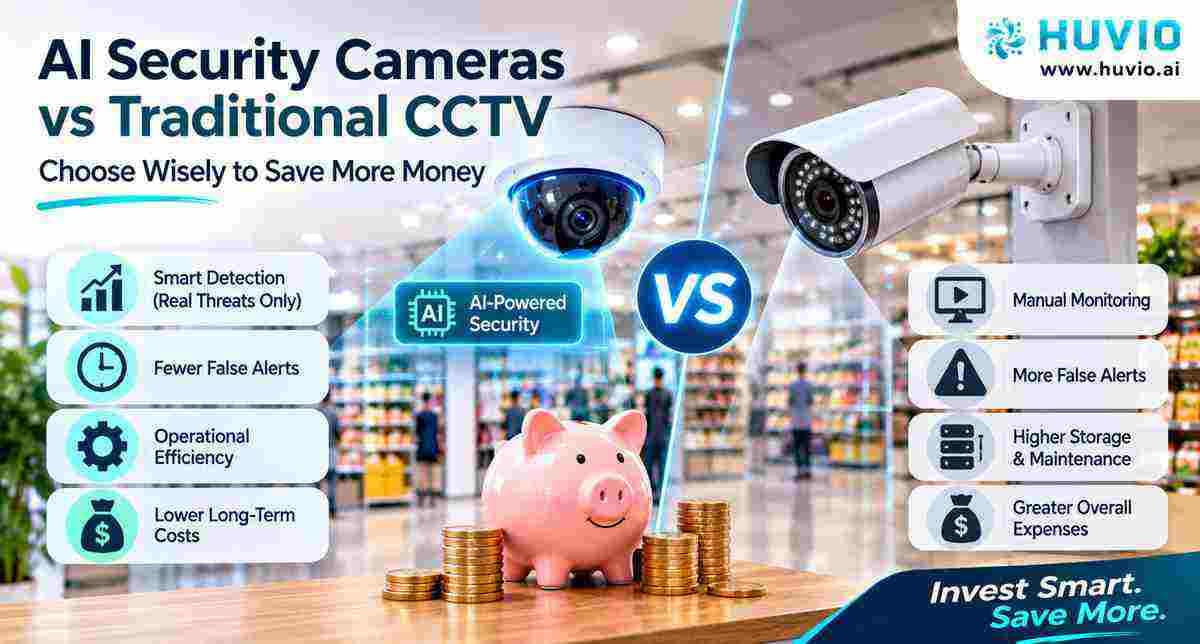
AI security cameras are becoming a leading choice for installation in homes and offices. However, people still think twice when comparing them with traditional cameras. The primary reason for this hesitation is cost. Traditional CCTV systems are generally cheaper than AI security systems, which offer advanced features such as facial recognition, behavioral detection, and motion analytics.
Judging both systems based on pricing alone can be misleading. The real question is, “Which system saves more money?” When you consider installation, monitoring, maintenance, scalability, labour expenses, insurance benefits, and loss prevention, the financial picture changes dramatically. Businesses evaluating retail security solutions need to consider these long-term expenses alongside the initial purchase price.
This article breaks down the cost comparison between traditional CCTV systems and AI security cameras to help you make an informed decision for your business or home security needs.
Initial Setup and Infrastructure Costs
Camera Hardware: Analog vs. AI-Powered
Traditional CCTV systems primarily rely on analog cameras and DVRs. This makes them a practical choice for organizations that need basic surveillance without stretching their budgets. [1] These cameras are cheaper, widely available, and easy to implement. [2]
On the other hand, AI security cameras consist of built-in processors, higher-resolution sensors, and intelligent analytics software, which increases their initial acquisition cost. [3] The cost of a single indoor camera starts at around $600 and can reach $1,000, with an annual license fee of approximately $199. [4] Businesses considering artificial intelligence security cameras should compare these upfront expenses with the potential savings over the system's lifetime.
The higher initial investment provides premium features such as:
· 2K–4K ultra-high-resolution video
· Facial recognition and object detection
· Behavioral analysis and smart alerts
· Wireless and cloud connectivity
· Integration with access control and alarm systems
AI cameras operate differently from analog cameras because they analyze visual data in real time, enabling them to transform security surveillance into an intelligent operational protection system.
Installation Complexity and Labor Costs
Sometimes, the cost of installation exceeds the cost of the camera itself. Traditional systems require additional components, such as separate cabling for power and video. Installing these systems in larger facilities takes more time and increases labor costs.
AI security cameras often support Power over Ethernet (PoE), which allows data and power to travel through a single cable. This reduces extra wiring, installation complexity, and labor requirements. The professional installation cost per camera is approximately $80–$200, depending on the following factors:
· Cable length and routing difficulty
· Indoor or outdoor placement
· Wall material
· System integration requirements
The installation budget for AI systems includes labor costs, which can account for 50–70% of total expenses. This may make these systems more cost-effective for large organizations that need to deploy them across multiple locations. [5] When comparing AI retail security systems with conventional CCTV, businesses should consider the combined cost of equipment, cabling, installation, and integration. Camera positioning also influences installation expenses, as retail camera placement standards help determine the coverage requirements and equipment setup needed across different store layouts.
Storage Costs: Local vs. Cloud
Traditional CCTV systems depend on DVRs or NVRs, which must be installed on-site and require hardware investment and ongoing maintenance. AI cameras can store video footage through cloud-based systems, reducing the need for physical server equipment. A retail surveillance system that uses cloud storage can also make footage easier to access across multiple locations.
Each AI camera produces approximately 15–20 GB of video data every day. Cloud storage typically costs around $0.02 per GB per month, or about $10 per camera each month for 30 days of retention. [6]
Many corporations choose hybrid models that combine:
· Local storage for continuous recording
· Cloud backup for critical footage
· Tiered retention periods of 30–90 days
Operational Efficiency and Labor Savings
Monitoring: Human Surveillance vs. AI Automation
Traditional CCTV requires human operators to watch camera feeds in real time. Research suggests that security personnel can monitor only ten to twelve camera feeds at once, and after twelve minutes, they may miss up to fifty percent of activity. [7]
AI security cameras do not get tired. They monitor feeds around the clock and can identify movement as it happens. These systems can flag suspicious behavior and send real-time alerts. [8] Staff members do not need to watch screens continuously; instead, they can respond when the system identifies a potential threat. [9] By automating routine monitoring, AI-powered surveillance can help security teams focus on incidents that require human judgment.
This reduces the need for continuous manual monitoring, improves response quality, and can save thousands of dollars in labor costs. Beyond security monitoring, AI for everyday store operations can help managers identify staffing gaps, service delays, and routine inefficiencies without reviewing hours of footage manually.
False Alarms
False alarms waste both time and money. In traditional systems, motion sensors can trigger alerts because of animals, weather conditions, or even shadows. Each alert consumes operational time and can contribute to alarm fatigue.
AI-powered systems can reduce false alarms by up to 95%, according to the stated claim. They can distinguish between people and animals and identify irrelevant movements caused by environmental changes. This helps security teams focus on genuine incidents rather than unnecessary alerts. For retailers evaluating AI retail theft detection, accurate alerts can be especially useful when prioritizing suspicious activity for investigation.
Maintenance
Traditional CCTV systems often rely on reactive maintenance. Equipment is repaired after it fails, which can lead to unexpected repair costs and operational disruption. AI surveillance systems can support predictive maintenance by monitoring camera health and performance.
This can help with:
· Detecting signs of potential equipment failure
· Identifying performance malfunctions
· Prioritizing maintenance tasks
These capabilities can improve system reliability and reduce maintenance costs by up to 25%, according to the cited claim. Many organizations have recovered part of their investment through fewer disruptions. [12]
Sustainability and Long-Term Cost Benefits
Scaling Surveillance
Scalability can distinguish the two systems. Traditional CCTV can be expensive to expand because adding a new camera may require additional DVRs, hard drives, and other hardware upgrades, leading to increased costs. [15]
Conversely, AI-powered surveillance can offer flexible, cloud-based scaling. It allows organizations to add cameras without necessarily making major hardware changes. Businesses can expand coverage across sites while maintaining more predictable expenses. This flexibility is one reason companies consider AI powered surveillance systems when planning multi-location deployments.
Centralized Multi-Site Management
Monitoring multiple sites with traditional CCTV systems can be complex and expensive. In contrast, AI security cameras can help teams manage multiple locations through centralized dashboards, depending on the platform and licensing plan.
This can help organizations:
· Reduce unnecessary site visits
· Standardize security policies
· Troubleshoot problems and deploy updates more quickly [18]
Centralized management can be particularly useful for retailers that need consistent oversight across stores. The right retail security software can bring alerts, footage, and system management together in one interface. This centralized information also creates opportunities for AI video surveillance for business intelligence, allowing retailers to evaluate customer traffic, staffing needs, and operational performance alongside security activities.
Software Updates and Improvements
Traditional CCTV systems may require hardware changes to support new features. AI security cameras can improve through software updates that introduce new analytics and capabilities without replacing the equipment. [16]
Cloud-based updates can reduce maintenance expenses by about 40% compared with older systems, according to the stated claim. However, actual savings depend on the provider, subscription fees, hardware compatibility, and the organization's existing infrastructure.
Return on Investment (ROI)
Faster Break-Even Point
Even though the upfront costs are higher, AI surveillance systems may deliver a return on investment within twelve to eighteen months. Labor savings, theft reduction, and lower maintenance expenses can contribute to the payback period.
Some organizations report six-figure savings from reducing guard services alone. [22] However, the actual break-even point depends on installation costs, licensing fees, operational requirements, and measurable savings.
Insurance Premium Reductions
Insurance companies may offer lower premiums for certain security improvements because they can reduce risk exposure. Some claims suggest premium reductions of 10–20% for AI surveillance deployments. [23] High-quality video footage can also speed up claims processing and help resolve liability disputes. [24] Businesses evaluating retail video surveillance should confirm any potential insurance discount directly with their insurer, since eligibility and savings vary by policy.
Theft and Loss Prevention
Retailers are using AI surveillance reports to measure security performance and identify opportunities to reduce losses. Reported outcomes include:
· A 30% reduction in shrinkage [25]
· 40% fewer successful break-ins [26]
· 35% faster incident response times [26]
These figures should be assessed against the original studies and the conditions in which the results were measured. For stores comparing retail theft prevention technology, the most useful measures include verified loss reduction, incident response time, and the cost of preventing each incident.
Privacy, Compliance, and Risk Management
When it comes to privacy, AI systems can offer useful safeguards. AI-powered platforms may include encryption, access controls, and face blurring, helping organizations manage privacy risks and meet applicable requirements. However, compliance with GDPR, HIPAA, and local regulations depends on how the system is configured and used. [29][31][32]
Traditional CCTV systems may also require additional safeguards or retrofitting to meet specific requirements. This can increase their long-term costs. [33] Organizations should compare the privacy features, security controls, and compliance requirements of each solution before choosing a system.
Conclusion
The initial cost of traditional CCTV systems is generally lower than that of AI security cameras, but AI cameras may provide substantial financial benefits over the long term. AI surveillance systems can improve financial performance by reducing labor expenses and false alarms, supporting predictive maintenance, simplifying expansion, potentially lowering insurance premiums, and helping prevent theft.
Organizations planning long-term security investments should compare the full cost of ownership rather than focusing only on the purchase price. By evaluating installation, subscriptions, maintenance, staffing, and measurable security outcomes, businesses can determine whether AI-based surveillance offers better value for their specific needs.
Find out how AI security cameras compare with traditional CCTV and discover smarter ways to reduce security costs without compromising store protection: https://huvio.ai/
References
[1] - https://intellisee.com/ai-security-cameras-vs-traditional-cctv/
[3] - https://bokysee.com/ai-based-security-camera-vs-traditional-surveillance/
[4] - https://wasabi.com/blog/video-surveillance/cloud-vs-local-storage-surveillance
[5] - https://www.eufy.com/blogs/security-camera/security-camera-installation-cost-is-it-worth-it
[7] - https://www.farsight.co.uk/blog/the-future-of-security-how-ai-is-enhancing-cctv-remote-monitoring/
[8] - https://www.nsoft.vision/traditional-vs-ai-video-surveillance
[9] - https://www.advantage.tech/comparing-traditional-cctv-with-ai-powered-surveillance/
[10] - https://intellve.com/how-artificial-intelligence-is-reducing-false-alarms-in-security-systems/
[11] - https://linkedsecurityny.com/blog/ai-powered-surveillance-cameras/
[12] - https://www.oracle.com/scm/ai-predictive-maintenance/
[13] - https://www.wolfeevo.com/future-of-ot-security-ai-predictive-maintenance-iot/
[15] - https://www.lumana.ai/blog/the-hidden-costs-of-video-surveillance-systems
[16] - https://volt.ai/blog/ai-video-analytics-vs-traditional-surveillance-why-intelligent-monitoring-wins
[18] - https://arcules.com/blog/finding-the-best-multi-site-security-system/
[19] - https://www.lumana.ai/blog/the-best-video-surveillance-software-of-2025
[20] - https://www.vortexcloud.com/
[21] - https://www.onec1.com/what-we-do/security/physical-security/advanced-surveillance-systems
[23] - https://www.ipcameras.co.za/the-role-of-ai-cameras-in-reducing-insurance-costs/
[25] - https://pavion.com/resource/minimizing-losses-the-impact-of-ai-video-surveillance-in-retail-loss-prevention/ [26] - https://www.arcadian.ai/es/blogs/blogs/5-key-differences-between-ai-surveillance-and-traditional-security-systems?srsltid=AfmBOopYWRv_pi70nStR17Adk1iDnd6kI4YXR2QIPq-6GwjXIr5yek8w
[27] - https://www.eufy.com/blogs/security-camera/security-camera-cloud-storage
[28] - https://dicsan.com/cloud-storage-for-security-cameras-vs-local-storage/
[29] - https://facit.ai/insights/face-blur-for-law-enforcement-agencies
[30] - https://www.themomentum.ai/blog/ai-and-hipaa-compliance-in-healthcare-all-you-need-to-know
[31] - https://techgdpr.com/blog/ai-and-the-gdpr-understanding-the-foundations-of-compliance/
[33] - https://indo.ai/data-privacy-in-ai-cameras-why-on-device-processing-matters/