
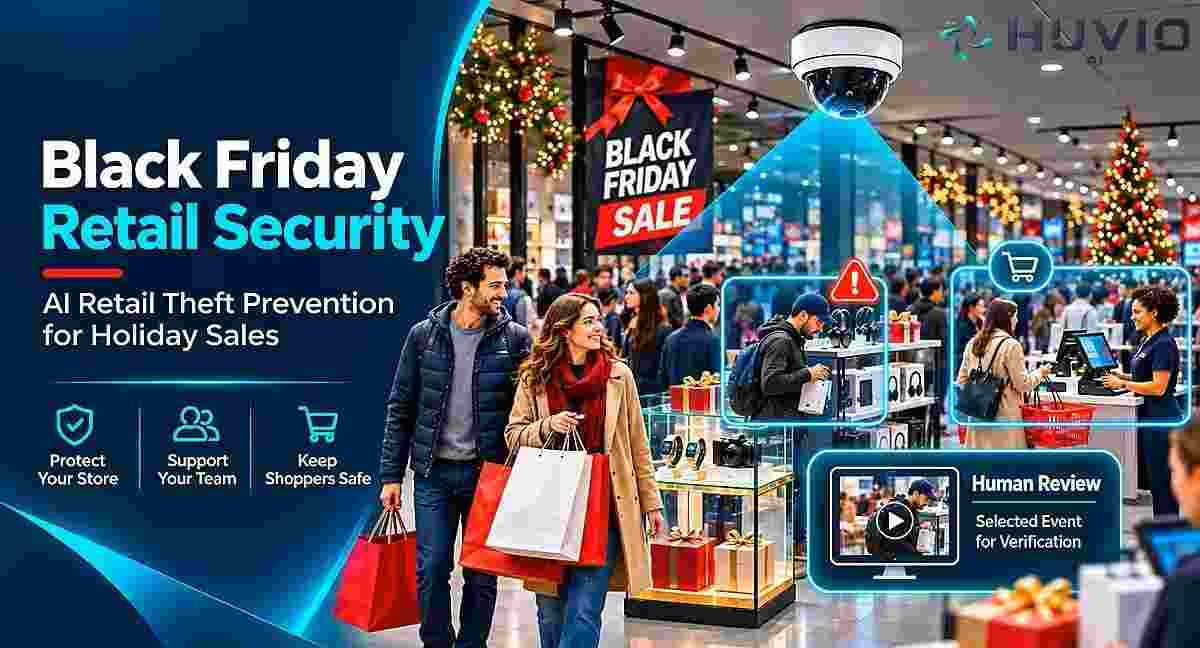
Black Friday and the holiday shopping season bring some of the busiest days of the year for retailers. Stores welcome more visitors, extend operating hours, run promotions, and manage larger volumes of transactions. While this period creates valuable sales opportunities, it also increases pressure on store teams. Crowded aisles, busy checkout areas, hurried replenishment, and high customer traffic can make it harder to notice suspicious activity. That is why retailers are increasingly considering practical retail theft prevention technology as part of their seasonal preparation.
Holiday security is not only about preventing shoplifting. It also involves protecting staff, supporting smooth customer experiences, reducing avoidable losses, and helping managers understand what is happening across the store. A thoughtful approach to AI retail theft detection can help teams review relevant activity more efficiently, while keeping employees focused on service and daily operations.
Why Black Friday Creates Extra Security Challenges
During major sales events, stores often experience a sharp increase in foot traffic. More shoppers in the same space can create crowded blind spots and make it difficult for employees to observe every aisle. High-demand products may be moved quickly, fitting rooms and self-checkout zones can become busy, and staff may need to divide their attention between customer questions, queues, and stock replenishment.
The risk is not limited to external theft. Operational mistakes can also become more common when teams are under pressure. Items may be misplaced, transactions may need extra review, and managers may not have enough time to investigate every incident as it happens. Retailers need a consistent way to identify relevant events, understand patterns, and decide which situations require attention.
Traditional monitoring methods can leave teams reviewing hours of footage after an incident has already occurred. Modern AI security systems can add another layer of support by helping highlight activity that may deserve a closer look. Used responsibly, these tools complement employee awareness and established loss-prevention procedures rather than replacing them.
How AI Video Monitoring Can Support Store Teams
A modern AI video surveillance approach can help retailers make better use of cameras they already have. Instead of relying only on someone watching multiple screens continuously, AI-enabled analysis can help surface selected events for review. This can make it easier for authorized staff to focus on situations that may matter, particularly during peak trading hours.
For example, a retail store video surveillance setup may cover entrances, checkout counters, high-value merchandise areas, and other important zones. When connected to appropriate analytics, retail video surveillance can help teams review activity in context, check what happened before and after an event, and follow consistent investigation procedures. The goal is not to treat every unusual movement as wrongdoing; it is to provide useful information that supports a fair human assessment.
AI-powered video surveillance can also support more structured review workflows. Teams may be able to search for relevant time periods or locations instead of manually watching long recordings from beginning to end. A well-planned AI video surveillance system should fit the store layout, camera quality, network capacity, privacy requirements, and the retailer’s operating policies. This approach to AI-powered video surveillance helps retailers combine timely incident detection with clear review procedures and informed staff responses.
Areas That Deserve Attention During Holiday Trading
Checkout and self-checkout areas often become congested during Black Friday promotions. Retailers can review queue activity, transaction procedures, and camera coverage to identify where staff support or clearer customer guidance may be needed. Technology should be configured to support review, not to make assumptions about a shopper based on a single gesture or isolated image.
High-value product displays may also need thoughtful coverage. Electronics, cosmetics, accessories, and other frequently targeted merchandise can be placed in areas that are visible to staff. Camera positioning should minimize blind spots while respecting customer privacy. Retailers should also make sure that shelves, promotional stands, and seasonal decorations do not unintentionally block important views. Entrances, exits, fitting-room approaches, and stockroom access points deserve attention as well. A retail surveillance system is most useful when its coverage reflects the actual flow of people and merchandise through the store. Managers should walk the floor before the season begins, compare camera views with real conditions, and correct gaps where possible.
Choosing Retail Security Solutions That Fit Your Store
Retailers evaluating retail security solutions should begin with their operational needs rather than choosing technology based only on a long feature list. Consider the number of locations, existing cameras, store layout, daily incident volume, staffing model, and the type of reporting managers need. A solution that works for one small store may require a different configuration across a large retail chain. Store layout is another important factor, as following retail camera placement standards helps retailers maintain effective coverage across different store sizes and configurations.
When comparing AI retail security systems, ask how events are identified, how alerts are reviewed, what information is retained, and who can access recordings. Understand whether the platform can work with existing infrastructure and what installation or integration effort may be involved. It is also important to understand how the system handles uncertain situations and how human review is included in the process.
Retail security software should be evaluated for usability as well as technical capability. Store managers and loss-prevention teams need clear workflows, relevant information, and practical ways to document investigations. During the holiday rush, a complicated tool can create more work instead of reducing it. Ask for a demonstration based on realistic store scenarios and make sure the people who will use the system have an opportunity to test it.
Retailers researching artificial intelligence security cameras or the best AI security cameras for retail stores should compare camera compatibility, image quality, placement requirements, analytics options, privacy controls, support, and total cost of ownership. The best AI surveillance software is not necessarily the platform with the most alerts. It is the one that provides useful, explainable information and fits the retailer’s existing processes.
Prepare Existing Cameras Before the Holiday Rush
A retailer does not always need to replace every camera to improve monitoring. Before investing in new equipment, review the current camera inventory and test important views during both quiet and busy periods. Check lighting, image clarity, timestamps, recording retention, network reliability, and whether the selected areas are covered properly. These steps help determine whether an upgrade, repositioning, or software integration is the most sensible next move.
AI powered surveillance systems may be considered when a retailer wants to add analytics to an established camera environment. Ask vendors to explain compatibility requirements and demonstrate how the system performs under real store conditions, including crowds, changing lighting, and partially obstructed views. A short pilot in selected locations can help teams understand accuracy, usefulness, and the level of staff training required before a wider rollout.
A practical deployment should also define responsibilities. Decide who receives alerts, who can review footage, how incidents are recorded, when managers escalate concerns, and how long relevant data is kept. Clear procedures reduce confusion and help ensure that technology is used consistently across shifts and locations.
A Responsible Approach to AI-Powered Surveillance
AI-powered surveillance should be introduced with transparency, oversight, and respect for privacy. Retailers should follow applicable laws and internal policies, post required notices, restrict access to authorized personnel, and establish appropriate retention periods. They should also train employees on what the system can and cannot determine. Video analytics can highlight activity for review, but a person should assess the context before taking action.
Retailers should avoid relying on demographic assumptions or treating ordinary customer behavior as proof of theft. Good governance includes regular checks for false alerts, review of system performance, clear escalation standards, and a way for employees to report problems. These safeguards help maintain trust with customers and staff while supporting effective loss prevention. When applied consistently, these safeguards allow AI retail security to support a safer and more comfortable shopping experience without treating normal customer behavior as suspicious.
How Huvio Fits into a Retail Security Strategy
Huvio focuses on AI-powered video intelligence for retail environments. Retailers exploring Huvio can consider how an AI-enabled approach may fit alongside their current cameras, store procedures, and loss-prevention goals. Before adopting any platform, teams should review the product’s current capabilities, integration requirements, deployment model, and data-handling practices against their own needs.
For a retailer preparing for Black Friday, the value of a platform such as Huvio should be assessed through practical questions: Does it help the team find relevant footage more efficiently? Can managers understand and review the information presented? Does it fit the existing store environment? Are the privacy and access controls appropriate? A measured evaluation is more useful than choosing a tool based on broad promises.
Black Friday Retail Security Preparation Checklist
· Review camera coverage at entrances, exits, checkout zones, high-value displays, and stockroom access points.
· Test image quality, lighting, timestamps, recording, network reliability, and storage before promotional traffic increases.
· Identify busy periods and locations where staff may need additional support or clearer procedures.
· Review AI alerts and analytics with human oversight; do not treat an alert as a conclusion.
· Train employees on incident reporting, footage access, escalation steps, and customer privacy.
· Confirm who can access video, how investigations are documented, and how long information is retained.
· Run a limited pilot when introducing new technology, then assess usefulness before expanding it.
Conclusion
Black Friday and the holiday season are demanding for retail teams. Higher foot traffic, more transactions, and limited staff attention can make loss prevention more challenging just when stores need to deliver a smooth shopping experience. A balanced strategy combines thoughtful store layouts, trained employees, clear procedures, reliable camera coverage, and carefully selected technology.
AI retail theft prevention can support this strategy when it is deployed responsibly and evaluated against real operational needs. Retailers should compare solutions, test them in context, and keep human judgment at the center of every important decision. With preparation and the right processes, stores can approach the holiday rush with stronger visibility, more consistent incident review, and greater confidence in their security operations.
Black Friday brings bigger crowds and greater risks. Stay one step ahead with smarter retail protection powered by Huvio AI — https://huvio.ai/
Frequently Asked Questions
Can AI help retailers during Black Friday?
AI tools can help highlight selected video events and make relevant footage easier to review. They work best as support for trained staff and established loss-prevention procedures.
Do retailers need to replace their existing CCTV cameras?
Not necessarily. Compatibility depends on camera quality, infrastructure, and platform requirements. Retailers should assess current equipment before deciding whether upgrades are needed.
What should retailers check before choosing an AI security platform?
They should review accuracy, ease of use, integration, privacy and access controls, reporting, support, training needs, and total cost. A pilot can help validate the fit.