
Every retailer knows the number by heart, even if they wish they didn't. Shrink quietly eats into margins year after year, and the traditional fix—hire more loss prevention staff, add more guards, walk more floors—isn't realistic for most stores anymore. Labor budgets are tight, qualified security hires are hard to find, and asking an already-stretched team to "watch the floor more closely" just isn't a plan. Effective retail security solutions can help address this challenge without adding staff.
That's exactly why AI has become the most practical answer to an old problem. Modern retail theft prevention technology doesn't ask you to add headcount; it asks your existing team to work smarter, with software doing the constant watching so people can do the intervening. If you're trying to reduce retail shrinkage this year without expanding payroll, here's how AI actually makes that possible.
A useful starting point is understanding the full cost of retail theft, including the operational losses that do not always appear in a single incident report.
Why Traditional Retail Loss Prevention Falls Short
Most stores still rely on a mix of passive CCTV, occasional in-person spot checks, and after-the-fact inventory audits. The problem is timing. By the time a loss shows up in a stock count, the item is long gone. By the time a manager reviews security footage, they're often just confirming what they already suspect, not preventing anything.
Traditional retail loss prevention is reactive by design. A single employee can't watch six camera feeds, run the register, help customers, and restock shelves all at once, and even if they could, human attention naturally drifts after 20 minutes of watching a static screen. This isn't a discipline problem. It's a bandwidth problem, and no amount of extra effort from your current team solves it on its own.
How Retail Security Technology Is Changing the Equation
AI-powered surveillance flips the model from reactive to proactive. Instead of a person watching every camera at once, the software watches all of them, all the time, and only surfaces what actually matters. This approach supports AI-powered surveillance across existing camera feeds.
That shift is possible because AI retail theft detection analyzes activity across camera feeds instead of leaving every decision until footage is reviewed afterward.
This is the core shift happening across the industry right now: computer vision models trained specifically on retail environments can recognize suspicious behavior patterns, concealment, loitering near high-value items, unusual movement around checkout, and flag them the moment they happen, not after the loss occurs. That single change, moving detection from "after the fact" to "in the moment," is what makes it possible to reduce retail shrinkage without adding a single new employee.
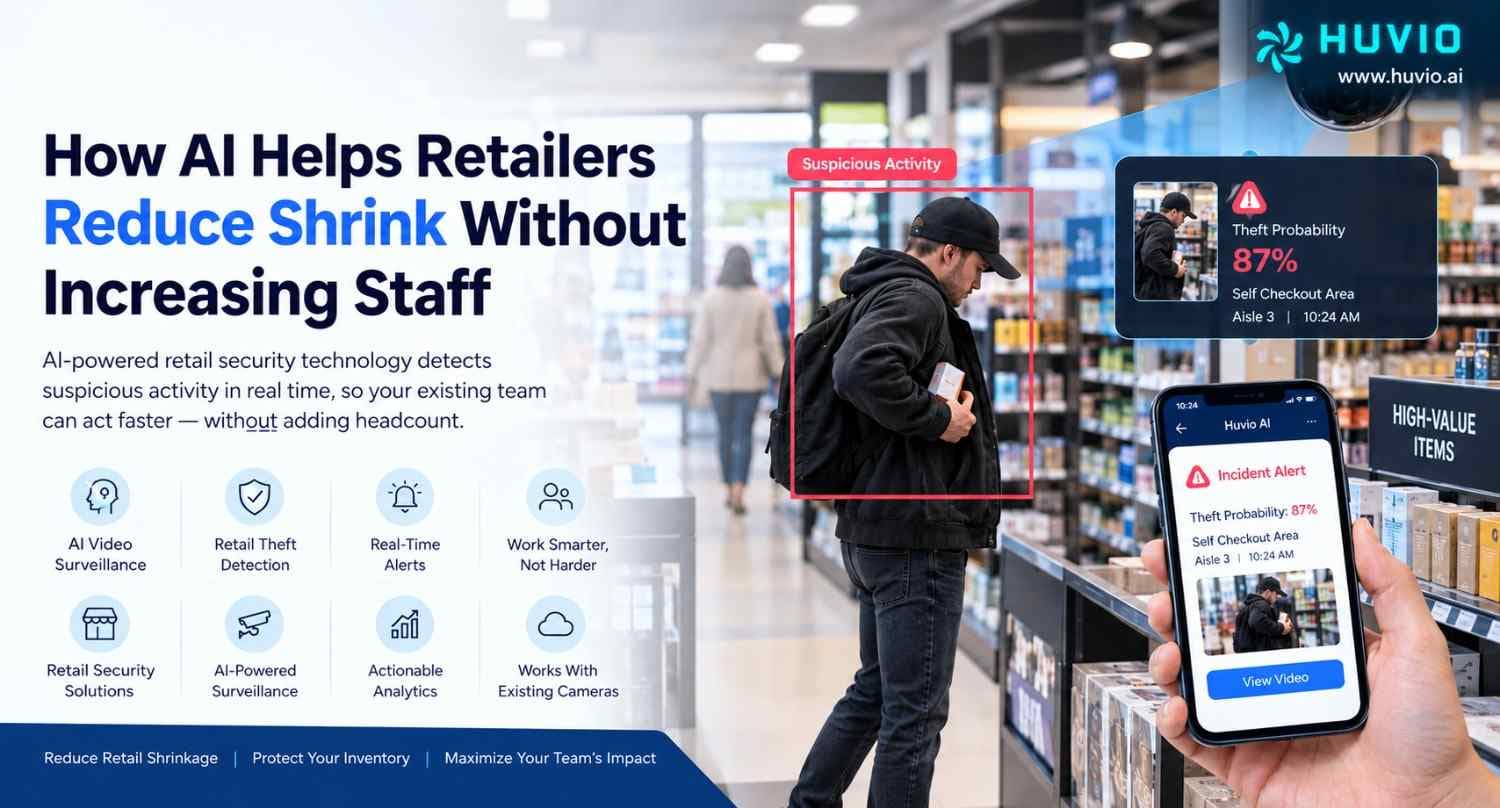
Platforms like Huvio AI are built around exactly this idea. Huvio connects to the cameras a store already has and analyzes footage in real time, assigning each flagged incident a theft-probability score so staff instantly know how urgent it is. Rather than reviewing hours of footage after inventory comes up short, a manager gets an alert on their phone the moment something looks off, with a clip, a location, and a confidence score attached. This is an example of retail security software designed for real-time incident review.
Doing More With the Team You Already Have
This is really the heart of the shift: AI doesn't replace your loss prevention strategy; it multiplies the people already executing it. A few ways this plays out on the floor:
Alerts replace constant monitoring. Nobody needs to be assigned to "watch the cameras" for an entire shift. The system does that continuously, and staff only get pulled in when there's something worth their attention, turning passive surveillance into active, targeted response.
Prioritization replaces guesswork. With a probability score attached to every incident, a single loss prevention associate, or even a store manager wearing multiple hats, can triage in seconds. High-confidence incidents get an immediate walk-over; lower-confidence ones can be reviewed later. That's a level of efficiency a two- or three-person LP team simply couldn't manage manually.
One person can effectively cover multiple locations. Because detection happens in the cloud rather than requiring someone physically present at each site, a regional loss prevention manager can monitor incidents across five stores from a single dashboard instead of needing a dedicated person at each one. For multi-location retailers, this is often where the labor savings are most dramatic.
Data replaces intuition. Beyond individual incidents, AI systems build a pattern over time: which departments see the most flagged activity, which hours are highest risk, which locations need a second look. That means staffing and attention can be allocated based on evidence, not gut feeling, making every labor hour count for more.
Those patterns also put individual store losses into the context of the wider rise of retail theft, where prevention increasingly requires visibility across departments and locations.
What This Looks Like in Practice
Picture a mid-sized grocery or electronics retailer running lean on staff, like most are today. Self-checkout lanes, high-value displays, and multiple departments all need eyes on them, but there's no budget for a dedicated overnight security hire.
With a system like Huvio in place, cameras that are already installed start doing double duty. The AI continuously scans self-checkout areas and high-shrink zones, and when it detects behavior consistent with concealment or an unusual pattern around a display case, it creates an incident automatically, complete with a stealing-probability score, often reported in the 80%+ accuracy range for confirmed cases. A manager or the closest available staff member gets a mobile alert and can intervene in real time, rather than discovering the loss during next month's inventory count. It can function as a retail surveillance system for existing high-risk areas.
Over time, the incident analytics and reporting dashboard shows trends: which hours, which aisles, and which stores are seeing the most activity. That insight lets a lean team focus energy exactly where it's needed instead of spreading thin coverage across an entire store, every hour, every day.
Getting Started Without Overhauling Your Operation
One of the most underrated advantages of AI-based retail security technology is how little disruption it requires. There's typically no need to rip out existing cameras or retrain an entire team on a new physical security process. Cloud-based platforms plug into infrastructure that's often already in place, with real-time alerts delivered through a simple mobile app or dashboard. These tools can form part of broader ai security systems.
For retailers evaluating options, it's worth asking a few questions: Does the platform work with existing cameras, or does it require new hardware? How is pricing structured, per camera, per location, flat enterprise rate? And critically, how accurate are the incident alerts, since a system that cries wolf too often just adds noise instead of reducing it?
The Bottom Line
Shrink isn't going away, and neither is the pressure to run lean. But reducing loss no longer has to mean expanding your team. AI-driven retail security technology lets existing staff act on real-time, prioritized information instead of trying to be everywhere at once, turning a handful of people into a genuinely capable loss prevention operation. For retailers ready to reduce retail shrinkage without adding headcount, that shift from reactive monitoring to proactive, AI-assisted detection is where the real savings start.
Protect Your Store with Huvio AI. Visit Our Website Today: https://huvio.ai/