
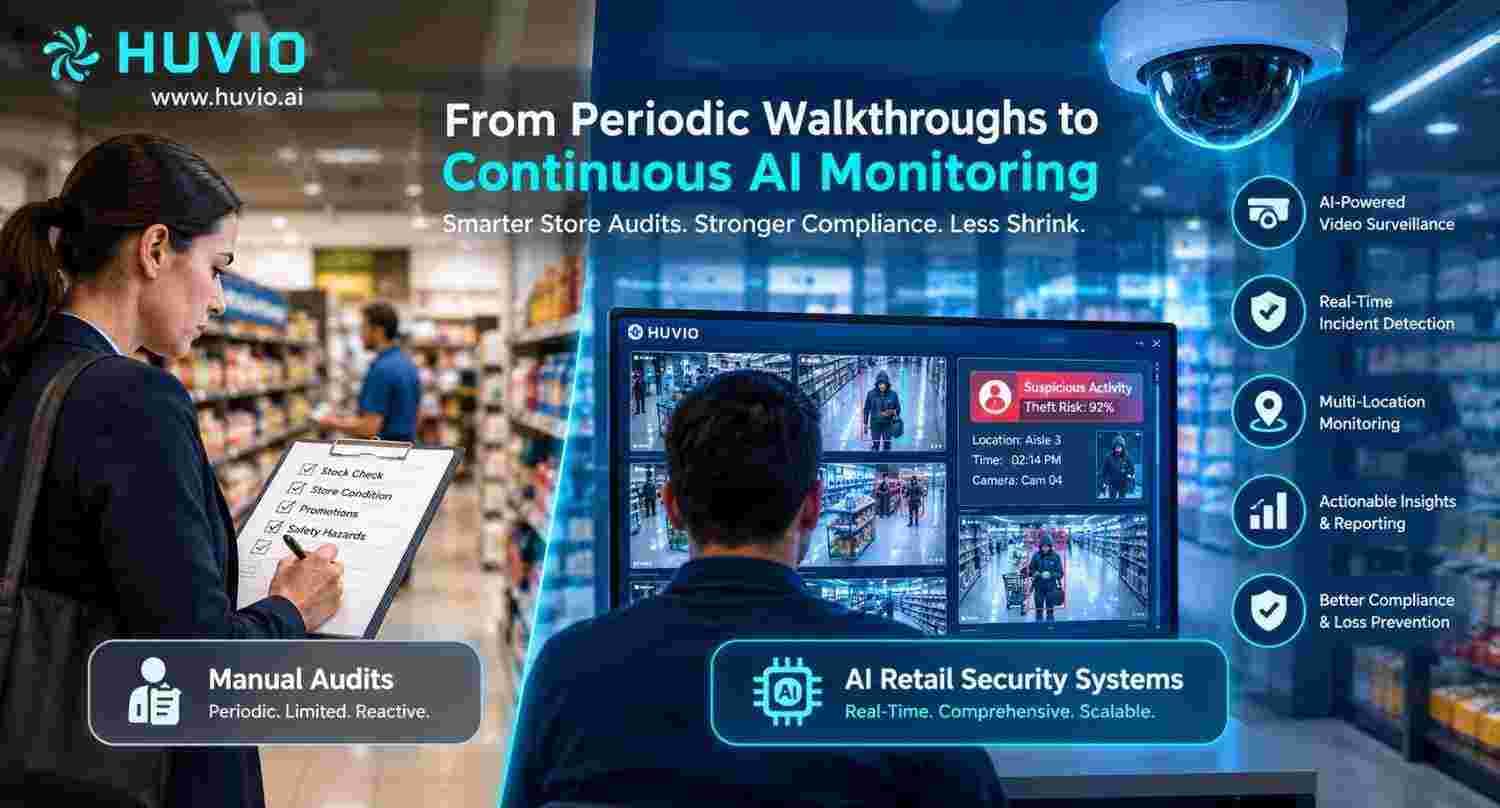
A district manager walks into a store on the second Tuesday of the month, clipboard in hand. She checks the shelves, reviews the stockroom, notes a few issues, and leaves. Three weeks and five days later, she's back. In between, anything could have happened and usually does. AI retail theft detection can help identify relevant risks between these visits.
This is how store audits have worked in retail for decades: a snapshot, taken once a month, of a business that changes every hour. It's a system built for a slower era of retail, and it's quietly costing chains millions. That's why a growing number of multi-location retailers are replacing the clipboard walkthrough with continuous, AI-powered monitoring, and the shift is happening faster than most people realize.
The Problem Isn't the Audit. It's the Gap Between Audits.
Traditional retail compliance monitoring was never designed to catch problems in real time; it was designed to catch them eventually. Most retailers still run comprehensive audits monthly or quarterly, with only high-priority areas checked more often. Standard walkthroughs take one to four hours per location, which is manageable for a handful of stores but unworkable at scale for a 50-, 200-, or 1,000-location chain. Modern retail security solutions can help reduce these gaps.
The cost of that gap is enormous. Industry research shows that nearly a quarter of planned in-store promotions are never executed correctly, meaning marketing spend evaporates before a single customer sees the offer and nobody finds out until the next scheduled visit. Out-of-stocks alone are estimated to cost global retailers roughly $1.75 trillion a year, largely because shelf gaps go unnoticed between audit cycles. On the loss prevention side, U.S. retailers are expected to lose an estimated $90 billion to shrink in 2025, with organized retail crime groups increasingly exploiting the very coverage gaps that monthly inspections leave behind.
The old workflow makes the delay worse: an auditor visits a store, takes notes or photos, drives back to the office, and files a report, often two or three days after the actual incident. By the time a district manager sees the problem, it's history. The shoplifter is gone, the safety hazard has already caused an injury, the broken cooler has already spoiled the inventory. AI security systems can surface certain risks sooner.
What Continuous Monitoring Actually Looks Like
Continuous monitoring flips the model. Instead of a person periodically sampling a handful of stores, AI watches every store, every hour it's open, and flags what matters the moment it happens. This is where AI video surveillance can support a more continuous view of store activity.
This is the core of how Huvio approaches retail compliance monitoring: cameras already installed in a store feed live video into an AI system that's trained to recognize suspicious behavior as it unfolds, not after the fact. When the system flags a potential incident, it doesn't just log it; it generates an alert with a probability score (Huvio's detection consistently flags high-risk activity at 80%+ accuracy) so staff can decide, in seconds, whether to intervene. A monthly auditor might catch one shoplifting pattern by coincidence. A system that's watching continuously catches the pattern the first time it happens, and every time after. AI-powered video surveillance can help teams review activity more consistently.
The difference compounds across a chain. A regional manager checking in on 40 stores once a month is realistically looking at each location for a few hours a year. A continuous system is looking at all 40 locations, all day, every day, and only surfacing the moments that actually need a human's attention. Retail store video surveillance can make footage available for review between scheduled visits.
This wider visibility becomes retail operational intelligence when live observations inform staffing, compliance checks, and loss-prevention decisions across locations.
Rethinking Store Audits as an Ongoing Process, Not an Event
The retail operations world is increasingly describing this as a shift from periodic compliance checks to continuous performance management — audits become part of the daily operating rhythm instead of an isolated visit. Retail security software can help organize alerts and review workflows alongside these checks.
At the store level, real-time operational intelligence for managers makes that continuous approach practical by connecting alerts to decisions during the working day.
Retailers who've made this shift report meaningful gains: one 50-store chain that automated its audit and monitoring workflow cut documentation costs by roughly 65%, saving over $800,000 a year while actually improving response time. Others running structured, frequent compliance programs have pushed store compliance scores from the 65-75% range up past 90% within a year.
Huvio's dashboard reflects this same logic applied to loss prevention and store security. Instead of a single incident report filed after a monthly visit, managers get:
· Live Monitoring: real-time camera feeds from every location, viewable from one dashboard
· Incident Detection: automatic flagging the moment suspicious activity occurs, with time, location, and camera source attached
· Incident Review: recorded clips and case management, so staff can verify and act instead of guessing
· Reporting & Insights: trend data across time and locations, showing where risk is concentrated instead of waiting for a spreadsheet built from monthly notes
For chains with high-shrink categories- electronics, pharmacy, jewellery, grocery self-checkout- that visibility isn't a nice-to-have. Retailers using continuous AI monitoring for loss prevention have reported shrinkage reductions of up to 49%, simply because staff can intervene during an incident instead of discovering the loss during the next inventory count. An AI video surveillance system can support this kind of timely review.
Retail Operations Automation Is the Bigger Trend
Loss prevention is just the most visible piece of a larger shift. Retail operations automation, by using AI to handle the parts of store management that used to require a person physically present, is moving from pilot programs to standard practice across grocery, pharmacy, electronics, and specialty retail. The retailers adopting it fastest aren't necessarily the biggest chains; they're the ones who've done the math on what a three-week blind spot actually costs. AI retail theft prevention is one part of this broader move toward proactive store oversight.
Scaling this model still requires consistent deployment, because enterprise AI security deployment gaps can leave locations with very different results despite using similar technology.
Manual audits aren't disappearing overnight, and they still have a role; a trained eye catching nuance that a checklist misses is valuable. But as the standalone method for monitoring dozens or hundreds of stores, the monthly walkthrough is losing ground for a simple reason: it was built to catch problems eventually, and retail today can't afford eventually.
Making the Shift
For chains still relying on a scheduled walkthrough as their main line of defense, the question isn't whether to add AI monitoring; it's how much risk accumulates in the gaps while the decision gets delayed. Huvio was built to close that gap: real-time detection, instant alerts, and a multi-location dashboard that lets a lean team monitor stores the way a much larger audit team never could. AI-powered surveillance can help teams focus attention on flagged activity.
If a monthly snapshot is standing in for what should be continuous visibility, it's worth seeing what real-time monitoring looks like on your own floor. Get started with Huvio or talk to our team about your stores.
Get More info in One Click: https://huvio.ai/