
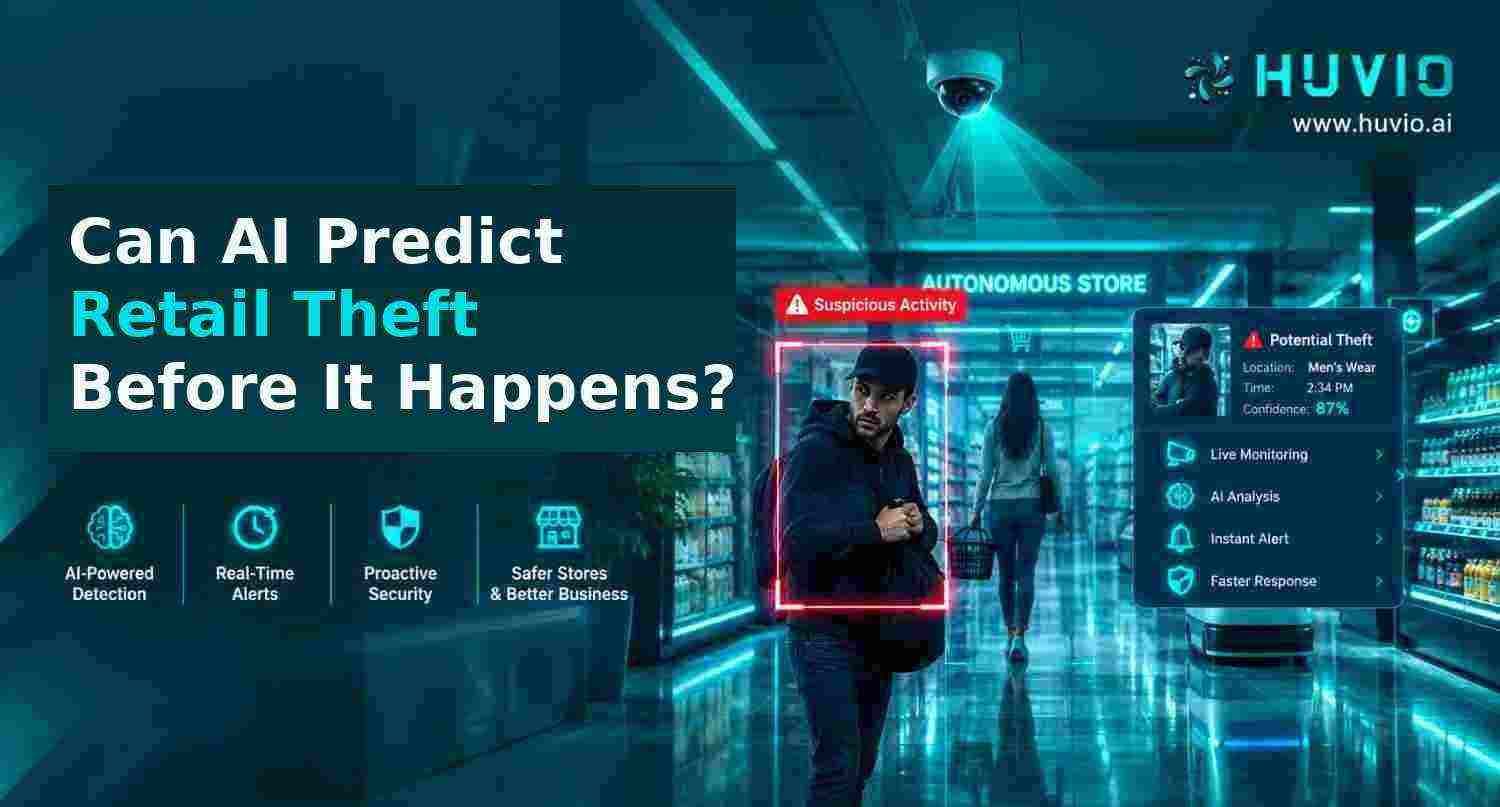
Retail theft rarely begins when an item disappears. In many situations, it involves a series of behaviors, retail theft prevention technology including repeated scanning of the surroundings, odd movement near merchandise, prolonged stay in high-risk areas, concealment, and attempts to flee without paying.
The issue is that standard CCTV systems only capture these instances. By the time a security crew watches the film, AI retail theft detection the incident has already occurred. This is where theft detection AI is transforming shop security.
Modern artificial intelligence can scan live footage, discern behavioral patterns, and detect activity that may signal a theft occurrence. While artificial intelligence cannot read a shopper's intentions or accurately foresee the future, AI-powered video surveillance advanced behavioral analytics can help merchants detect suspicious activity earlier, giving store personnel more time to intervene.
From Recording Theft to Detecting Risk
Traditional surveillance is primarily reactive. Following an incident, security staff monitor camera feeds retail security solutions and evaluate footage. However, human operators find it difficult to continuously monitor dozens of cameras. Important events are easily missed, especially during hectic times.
AI-enabled surveillance offers a new approach. Instead of merely recording what happens, AI video surveillance an AI system may analyze video streams in real time to detect patterns associated with questionable conduct. These could include strange interactions with products, concealing movements, frequent pacing around a certain location, or conduct that appears to be discordant with typical shopping behavior.
The strength of AI retail theft detection is its ability to assess several behaviors together for review, rather than concluding a single movement.
One of the most significant advancements in modern loss prevention technology is the change from "What happened?" to "What may be happening right now?"
Research into AI-based shoplifting prevention increasingly focuses on behavioral analytics and video-based anomaly detection AI retail theft prevention rather than relying only on traditional monitoring.
How Does Theft Detection AI Recognize Suspicious Behavior?
AI does not always need to identify a human to detect a potentially dangerous incident. Instead, computer vision models can assess movements, some AI video surveillance system interactions, and activity sequences.
For example, a system could identify a combination of signals like:
· A shopper spent an abnormally lengthy period in a high-risk location.
· Frequently gazing around while dealing with merchandise
· Picking up an item and moving it to a bag, pocket, or other concealing spot
· Using a product in a way that differs from typical shopping behavior
· Returning frequently to the same shelf.
· Following a dubious interaction, go immediately toward an escape.
An unusual succession of events during self-checkout. Individually, these acts could be entirely benign. The true usefulness of AI lies in its capacity to examine several inputs simultaneously and understand the larger context.
This is why new systems are progressing beyond simple "suspicious gesture" identification and into more complex event analysis. Recent research has looked into pose-based and temporal models that examine movement sequences rather than individual video frames.
Can AI Actually Predict Shoplifting Before It Happens?
The short answer is that AI can detect early warning signals but cannot predict a person's intentions with precision. The purpose of predictive shoplifting prevention is not to identify someone as a thief before a crime occurs. AI security systems Instead, AI can identify a pattern of behavior that may warrant intervention.
These early signals are one part of retail theft prevention technology, which helps employees respond to potential losses without treating a prediction as proof of wrongdoing.
Think of it as an early warning system.
For instance, an AI model could detect:
Product engagement leads to concealment-like movement, followed by ongoing suspicious activity and movement toward the exit.
When these signals occur simultaneously, the system can send an alert to a member of the retail team.
This allows staff to review the situation and respond according to the store's policies. AI can support human decision-making, AI retail security systems rather than automatically making accusations or taking action against customers. This distinction is important. The most effective retail security systems combine automated detection with human review.
Human review also depends on manageable notifications, since alert fatigue in retail security can make genuinely important warnings easier to overlook.
Why Behavioral Analytics Is Important for Retail Security
Many traditional security mechanisms center on identity. They pose queries like these:
Who is this individual?
Behavioral analytics poses a different question:
What is happening right now?
This method allows businesses to focus on observable activities rather than personal attributes. Artificial intelligence systems can assess movements and interactions without relying on facial recognition or identity tracking.
Some modern retail loss prevention strategies are also focusing on studying product mobility and the connection between merchandise encounters and payment events. This can provide more compelling proof of a potential loss occurrence than depending solely on looks or a single "suspicious" gesture.
This allows retailers to take a more tailored and less intrusive approach to security.
Real-Time Alerts Can Help Prevent Losses
The primary advantage of AI-powered theft detection is speed.
A typical camera system may record an incident. A human operator may eventually uncover it. By then, the chance to avoid the loss may have passed.
AI can continuously scan live camera feeds and send alerts when predetermined patterns are discovered. Retail store video surveillance
For example, a retail team may receive an alert containing:
· The camera's location
· A little video clip.
· The timing of the event
· Type of identified behavior
· A risk or probability score.
Huvio AI takes a proactive approach by delivering real-time AI surveillance monitoring, automatically creating incidents when suspicious activity is spotted, and assisting with incident assessment and reporting. Its AI-powered theft detection also generates a theft probability score to assist teams in prioritising probable events.
AI Can Also Reduce Alert Fatigue
One of the most serious issues in retail security is an excessive number of notifications. If a system sends out messages for every odd movement, employees may rapidly become overwhelmed. Important signals may eventually be ignored.
Context and priority are therefore critical for effective loss prevention technologies. Instead of treating every event as a theft, retail security software AI may help rate incidents based on the strength of the observed signals. A probable event with many indicators may be given higher priority than a single unexpected movement.
This method can assist security teams in allocating their time more effectively. The most recent research in retail AI is looking into systems that use lightweight detection models to identify probable occurrences before performing more complex analysis. This layered method can increase performance while avoiding wasteful processing and false alerts.
The Future of Shoplifting Prevention Is Proactive
The future of retail security is shifting away from passive observation.
The question is no longer simple:
"Can we review the footage after something happens?"
The most crucial question is:
"Can we identify potential risk early enough to prevent a loss?"
AI is assisting merchants in becoming more proactive in theft prevention through behavioral analytics, computer vision, real-time warnings, and intelligent incident management.
AI cannot predict every theft before it occurs. However, it can detect patterns, distinguish suspect sequences, and notify retail staff of potential issues faster than typical surveillance systems. This creates a significant opportunity for merchants dealing with increased shrinkage and limited security resources.
The future of theft detection AI does not involve replacing human judgment. It is about providing retailers with greater information, faster alerts, and more effective loss prevention technologies to assist in preventing theft before it becomes a complete loss.
The optimal moment to respond to retail theft may be before the final step. With AI-powered behavioral detection, stores can transition from just detecting theft to preventing it.
Discover how Huvio AI helps retailers detect suspicious behavior in real time, identify potential theft, and strengthen loss prevention with intelligent AI surveillance. Visit https://huvio.ai/